

At first I was flabbergasted1.
Why is this happening? How is this happening? This makes no f***ing sense at all!
A generic song I’d been paid to write for Capitol Studio Masters, a strange corporate offshoot of a subsidiary of a subsidiary of a record label, was suddenly—after years of almost zero listens—getting hundreds of Spotify “Radio” streams a day.

They tell us the algorithms respond to engagement: the more people save the song, add it to playlists, listen to it on repeat, the more the algorithm will serve that song to others. That makes sense.
Except this song in question had NO engagement whatsoever.
I’d never promoted it2, and it only ever got played if someone shuffled through my whole discography. No one was adding it to playlists, saving it, or seeking it out in any way.
So why, when I was actively promoting fresh singles, singles that were getting hundreds of human playlist adds and saves, was this derivative piece of shit that had been out for four years and been written in 45 minutes getting fed by the algorithms to more listeners than all of my other songs combined?
I was both angry and confused—but the confusion didn’t last long3.
Because I soon found Liz Pelly’s excellent reporting about Spotify’s Production Music Scandal.
Spotify is actively replacing art with generic knockoffs in order to cut costs and pay themselves.
A long investigative report in Harpers detailed how, through a series of shady shell corporations, Spotify was paying faceless “Production Companies” to produce what they called “Perfect Fit Content”: the production companies hire musicians, send them a playlist of songs to artlessly imitate, and pay them a few hundred bucks in order for the company to retain the rights to the songs instead of paying any royalties.
Turns out those Production Companies are actually owned by…Spotify themselves or their close corporate partners.
And, if that wasn’t bad enough, Spotify is, in turn, forcing their employees to prioritize those “PFC” songs on algorithmic playlists.
In other words, Spotify is actively replacing art with generic knockoffs in order to cut costs and pay themselves.
And whaddyaknow, I was an artist paid by an odd subsidiary to create a generic knockoff…and that song was suddenly killing it on the algorithmic playlists!
But that’s not even the end of the story.
Because I wrote that song in 2020. Generative AI did not exist back then.
Not only does it exist now, but the three major record labels have all signed licensing agreements with Generative AI companies like Suno and Udio—and taken equity stakes in those Generative AI companies to boot.
While Spotify is not technically a party to these agreements, Spotify is partially owned by those three major labels—and has done almost nothing to signal its interest in combating the rise of AI music.
Because AI music reduces Spotify’s costs.
Because AI music boosts Spotify’s profits.
Because Spotify’s primary incentive is to serve you music that won’t make you turn off Spotify.
I.e. they’d rather feed you inoffensive drivel than risk blowing your mind.
This means more generic music.
This means music that doesn’t challenge anything. This means music that is overly-familiar, easy, simple, derivative.
Elevator Music! Muzak. Corporate shit your uncle puts on at Thanksgiving via the Satellite TV.
Spotify has already been smushing our tastes for the better part of a decade, sending us “recommendations” of things that are easy to passively consume. It buries us in the stuff we’re already familiar with, prioritizing older songs we already know, catalogs controlled by their financial partners, or whatever’s just generic enough to not make you hit skip4.
And the worst part? We’re eating it up. Have been for a few years now. So, in comes AI, and instead of at least paying guys like me $300 bucks to make some slop, they can pay no one but themselves.
For artists, this means even fewer will break through…
and only the ones under corporate control. Fewer will be able to take a slice of what little money is out there to make, and fewer will create music that challenges expectations, that breaks the rules, that pushes new directions5.
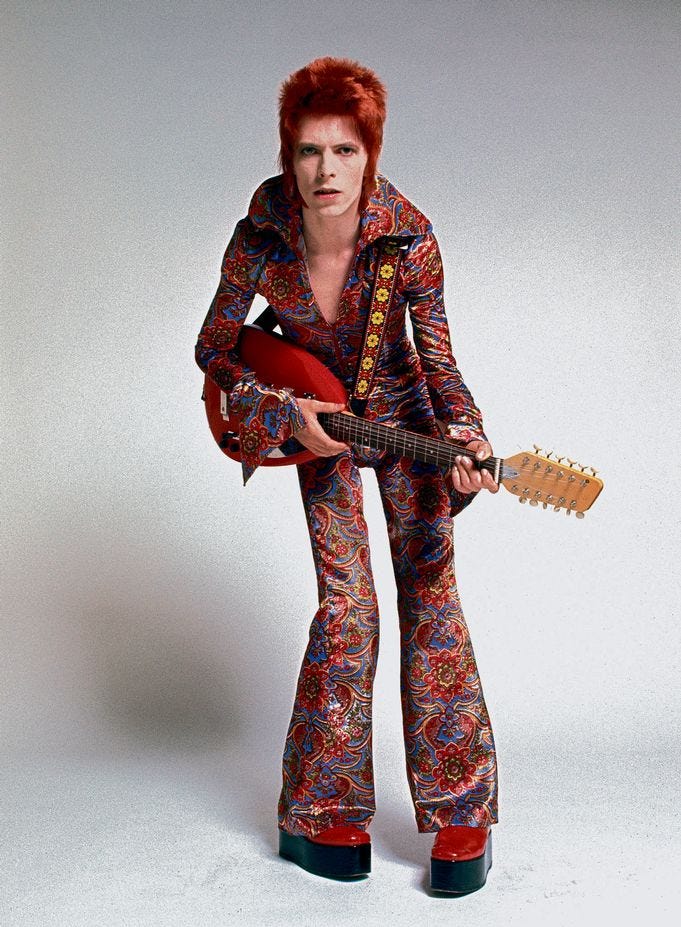
Ask yourself, would David Bowie and his bisexual, avant-garde art rock have made it onto your Spotify Daily Mix if he were just coming up today? What about Parliament? Patti Smith? Public Enemy? Anything that challenges the status quo or rocks the boat?
Do we really think Spotify would serve people “Like A Rolling Stone”—what with its 6-minute run time, disgruntled lyrics about knocking a rich kid down a peg or two, and it’s grating, monotonous vocal line—if it weren’t already a classic…and part of a catalog wholly owned by one of Spotify’s strategic partners?
For our society at large…
we are going to lose not just our ability to discern human from AI—that’s pretty much gone already—but we will lose the difference between generic and intentional.
In other words, we will lose art and be left just with diversion.
Something nice and easy to throw on, bland sonic wallpaper you won’t notice while you drown out whatever’s been overwhelming your psyche.
A colorless existence, brought to you by Spotify.
But, there is something we can do about it.
That’s coming on Friday.
‘Til then,
-David
Hear The Latest…
Want More Essays Like This?
Are We Human, or Are We Cancer?

Because proper human growth is not replication, it is inspiration.
In other words, it is imperfect.
Read “pissed the fuck off”
I wanted it off my page it was so damn cheesy
The anger is still here…
I refer to this as the “Adele-ification” of music. Back when Pandora was first a thing in the early 2010s, it didn’t matter what song you started with, it could have been Run The Fucking Jewels…wait long enough and you were going to get something off of 21. Why? BECAUSEEVERYONELOVESADELERIGHT?!
look at how they’re already force-feeding us Geese as if they were doing something new and avant garde…they aren’t.
When you were mentioning this in that discussion with Chris, I was only surprised that I didn’t already know about this scheme! It makes PERFECT sense from the corporate perspective: “let’s create a cycle where we own the entire music production of more generic work and forcibly control the distribution mechanism, thereby eating back our own gains and squeezing out artists not owned by us”.
I think you’re right: Bowie would not have been fed to us in a playlist that favors general ambient consumption music.
I’ve always suspected it but only recently found out it was true. Spotify has always been a disappointment for me. I used to pitch hard to get on playlists but then realized they seemed to only give a handful of the same people this option.
Like many things, it’s become a racket.