

It was the pandemic. I was bored, uninspired, and eager for some quick cash when a friend hit me up with an opportunity.
I could make $300 to write and sing a melody to a track he’d made for Capitol Records—now a wholly owned subsidiary of Universal Music Group, one of the three Major Labels that together control 70% of the American recorded music market and who all own a healthy investment in Spotify as part of the original carbon copy deals each signed when first allowing Spotify to license all the major music in the world—and while that sounds exciting on the surface, it is, in fact, very not exciting.
Let me explain
At the time, we were told we were making “Library Music” aka songs that Universal/Capitol/Sheinhardt Wig Company could record cheaply to which they’d maintain the rights—easy/soulless background music they could use whenever they liked without having to shell out money or clear any licenses.

They paid my friend $300 to make the track, and they paid me $300 to sing the top line—and then they’d get paid on anything they make going forward. They were looking for “Retro Soul” and sent us a playlist of early Leon Bridges, Mayer Hawthorne, Sharon Jones, and told us explicitly to make something that sounds just like that. The title of the compilation was literally “Soul Revived!” if that gives you a sense of how much creativity went into this.
The track is embarrassingly fine.
Its largest offense is its complete inability to offend.
It has a generic horn part, a “throwback groove,” and checking in at 2:15 is in, out, and over with in the time it took you to realize a song was playing. If you trained AI just on the music they play at Target, this is what you’d get1.
I wrote the lyrics/melody in about 45 minutes and recorded the vocals in about an hour on a cheap microphone in my bedroom. 1hr45 for $300…not bad for a music payday, thinking I’d finally gotten one over on the industry!
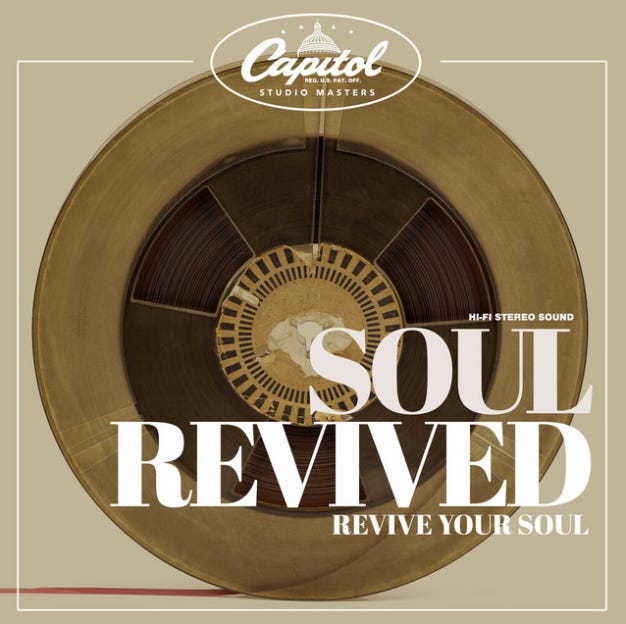
When it came out on Spotify under my name, I emailed my contact at Capitol/UMG and asked them to change it to a pseudonym because I didn’t want it to be part of my catalog. But they ignored me, so it sat there at the bottom of my Spotify discography collecting digital dust for several years.
But then, a funny thing started to happen: out of nowhere, Spotify Radio started playing it. This was 2024. It had come out 4 years prior and literally no one had touched it. It had no engagement: no saves, no playlist adds, no repeat listens. Nada. But it was, inexplicably, getting more and more plays.
A glance at my “Spotify For Artists” dashboard showed that 99% of its streams were coming from “Spotify Algorithmic Playlists,” and almost exclusively from “Radio”— not “Discover Weekly” or one of the mood playlists people might choose to listen to. In other words, it was only getting plays when someone just let Spotify run endlessly, or, more to the point, when someone chose the listening experience with the least possible intentionality.
More frustrating still was that I’d just recently started releasing songs from a new record—a record that I’d spent 2.5 years making, spent unreasonable amounts of money on, that was recorded in a pro studio with a Grammy-nominated producer and some of the best musicians in the world. Whatever you think of that record—it’s complex, eclectic, not meant for everyone—it was made with intention and effort and in an attempt to make you think and feel something. It’s an expression of human experience, made with love and care.

At the time I was actively promoting the lead singles, chosen because they were the most digestible, the easiest to fit on a playlist: Jitney Bus Blues, Time & Time Again, Ash & Smoke. These songs had clear genres and moods. They got placed in dozens of playlists by independent curators and DJs (aka real people). They had strong save rates, lots of playlist adds, plenty of repeat listeners and people searching for ‘em by name or by heading specifically to my page.
But they got no love from the algorithms—despite Spotify’s stated assurance that high engagement rates lead to more algorithmic plays. And slowly but surely, “Chance On Me,” the musical equivalent of peel-and-stick wallpaper, has become my most played song2.
Spotify has decided it will feed this song to people and not my actual art.
This means, when someone discovers my music—at a show, through a friend, or, inshallah, the internet—they will head to my Spotify page, click play, and hear a song that has nothing to do with me and zero artistic value.
Despite my many midnight lamentations, I soon found out that that this was not, in fact, some silly algorithmic accident.
It was Spotify’s corporate strategy.
It was, in fact, very intentional.
Turns out, thanks to some crack investigative reporting, Spotify has been quietly paying production companies to make what they call “Perfect Fit Content,” songs made explicitly to fit a mood or a playlist, songs made with no heart, no soul, no artistic intention.
Why?
Because these songs are neither made nor owned by artists but by a series of shell companies and wholly owned subsidiaries all shadily tied back to Spotify because that way Spotify can prioritize the songs they and their partners own and essentially just pay themselves.
We’re just sheep, after all, so might as well feed us slop if it’s good for the bottom line.
And here’s the kicker: that was before AI existed…
Stay tuned for Part II,
-David

And yes, this is foreshadowing…
My catalog now has a 10 song album, a 4-song EP, all recently released, and, going back further, an 8-song album with hundreds of thousands of listens—but Chance On Me is at the top of my Spotify page…despite the fact that no one chooses to listen to it. Just needed to say that again because it makes me fucking enraged.
It’s tough because I’d love to move to bandcamp but I also know because of convenience few will follow me there…